The
ratio of the number of apples in Box A to the number of apples in Box B
is 3 : 2. All the apples in Box B are green. The ratio of the number of
green to the number of red apples in Box A is 4 : 5. There are 20 more
green apples in Box B than in Box A. How many red apples are there?
Solution
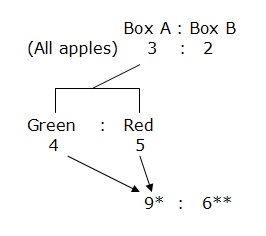
* 4 units of green apples + 5 units of red ---- 9 units in Box A
** 3 units in Box A (x 3) ---- 9 units, hence 2 units in Box B (x 3) will give 6 units.
Green Apples
Box B - Box A ----- 20
6 units - 4 units ----- 20
2 units ----- 20
1 unit ----- 20 divided by 2 = 10
Red Apples
5 units ----- 5 x 10 = 50
Answer: 50 red apples
Printer Friendly Version
Showing posts with label Ratio. Show all posts
Showing posts with label Ratio. Show all posts
Tuesday, September 11, 2012
Red Swastika Sch 2011 PSLE Math Prelim Paper 2 Q8

Wednesday, September 14, 2011
Catholic High School 2010 PSLE Math Prelim Paper 2 Q18
At a conference made up of speakers and participants, there were 20% more men than women. The ratio of male speakers to female speakers was 8:5. There was an equal number of male and female participants.
a) Find the ratio of male speakers to male participants at the conference.
b) Halfway, 40 male participants left the conference and another 60 female participants joined the conference. In the end, there were 3/4 as many male participants as female participants remaining behind. How many speakers were there at the conference?
Solution
Male ----- 120%
Female ----- 100%
Speakers
Male : Female
8 (parts) : 5 (parts)
Participants
Male : Female
1 (unit) : 1 (unit)
Men ----- 8 parts + 1 unit
Women ----- 5 parts + 1 unit
But since there are 20% more women than men,
Women ----- 5 parts x 120% + 1 unit x 120%
= 6 parts + 1.2 units
Men ----- Women
8 parts + 1 unit ----- 6 parts + 1.2 units
8 parts - 6 parts ----- 1.2 units - 1 unit
2 parts ----- 0.2 unit
1 part ----- 0.1 unit
10 parts ----- 1 unit
or
1 unit ----- 10 parts
(a)
Male Speakers ----- 8 parts
Male Participants ----- 1 unit or 10 parts
Male Speakers : Male Participants
8 : 10
4 : 5
Answer: 4 : 5
(b)
Speakers
Male : Female
8 (parts) : 5 (parts) -- (altogether 13 parts)
Participants
Male : Female
1 (unit) : 1 (unit)
10 (parts) : 10 (parts) -- (before)
- 40 : + 60 -- (40 males left; 60 females joined)
3 (units) : 4 (units) -- (3/4 as many male as females in the end)
(Male) 3 units ----- 10 parts - 40
(Female) 4 units ----- 10 parts + 60
(Female) - (Male)
4 units - 3 units ----- 10 parts + 60 - 10 parts - (-40)
1 unit ----- 60 + 40
1 unit ----- 100
(Male after)
3 units ---- 3 x 100 = 300
(Male before)
10 parts ---- 300 + 40 (need to add the 40 who left)
10 parts ----- 340
1 part ---- 34
All speakers
13 parts ---- 13 x 34 = 442
Answer: 442 speakers
Printer Friendly Version
Wednesday, September 07, 2011
Hokkien Huay Kuan Combined Primary 2010 PSLE Math Prelim Paper 2 Q16
Yanling had 60% more stamps than Lena. Tricia had 75% fewer stamps than Yanling. Yanling and Lena gave Tricia some stamps in the ratio 4:1. As a result, Tricia had 2 and 1/2 times as many stamps as before and Yanling had 300 stamps more than Lena in the end. How many sttamps did Lena give to Tricia?
Solution
*** Tricia had 75% fewer stamps than Yanling
----- 25% of 160% is 40%.
# Tricia finally had 2 and half times as many stamps as before
----- 40% x 2.5 = 100%
Tricia's number of stamps increased by
---- 100% - 40% = 60%
Ratio given by Yanling and Lena was 4:1 -----
Y : L
4 : 1
(Total 5 units) ----- 60%
**(Lena gave) 1 unit ----- 60% divided by 5 = 12%
*(Yanling gave) 4 units ---- 4 x 12% = 48%
In the end, Yanling had more than Lena ----- 300
112% - 88% ----- 300
24% ---- 300
1% ---- 300 divided by 24 = 12.5
Lena gave Tricia 12% -----
12 x 12.5 = 150
Answer: 150 stamps
Printer Friendly Version
Hokkien Huay Kuan Combined Primary 2010 PSLE Math Prelim Paper 2 Q9
The number of pens in Box X and Box Y are in the ration of 3:2. All the pens in Box Y are green. The ratio of green pens to blue pens in Box X is 4:5. There are 12 more green pens in Box Y than in Box X. How many blue pens are there?
Solution
Green in Box X
(4/9) x (3/5) = 4/15
There are 12 more blue pens in Box X than in Box Y
(2/5) - (4/15) ----- 12
(6/15) - (4/15) ----- 12
2/15 ----- 12
1/15 ----- 12 divided by 2 = 6
Blue Pens
(5/9) x (3/5)
= 1/3
= 5/15
5/15 ----- 5 x 6 = 30
Answer: 30 blue pens
Printer Friendly Version
Tuesday, May 03, 2011
ACS Primary 2010 SA1 Math Paper 2 Q18
Keane bought some marbles and gave half of them to Leon. Leon then bought some stamps and gave half of the to Keane. Keane used 5 stamps and Leon gave away 11 marbles. The ratio of the number of stamps to the number of marbles Keane had left then became 1:7 and the ratio of the number of stamps to the number of marbles Leon had left became 1:5. How many stamps did Leon buy?
Solution
M ----- Marbles
S ----- Stamps
Step 1
Keane bought marbles and gave half to Leon,
Keane ----- M
Leon ----- M
Both have same number of marbles.
Step 2
Leon bought stamps and gave half to Keane,
Keane ----- M , S
Leon ----- M , S
Now both have same number of marbles and stamps
Step 3
Keane used 5 stamps, Leon gave away 11 marbles,
Keane ----- M , [S - 5]
Leon ----- [M - 11] , S
Now Keane has 5 stamps less, and Leon 11 marbles less
Step 4
Keane's no. of stamps to no. of marbles now is 1:7,
M ----- (7 units)
[S - 5] ----- (1 unit)
Now Keane has 7 times as many marbles as stamps.
Step 5
Leon's no. of stamps to no. of marbles now is 1:5,
[M - 11] ----- (5 parts)
S ----- (1 part)
Now Leon has 5 times as many stamps as marbles.
Step 6
1 unit of Keane's stamps + 5 ----- 1 part of Leon's stamps
1 unit + 5 ----- 1 part
Keane gave away 5 stamps, so to have an equal no. of stamps as Leon now, we add back the 5 stamps Keane gave away.
Step 7
7 units of Keane's marbles ----- 5 parts of Leon's marbles + 11
7 units ----- 5 parts + 11
Leon gave away 11 marbles, so to have an equal no. of marbles as Keane, we add back the 11 marbles Leon gave away.
Step 8
Comparing marbles with stamps
(Stamps) 1 unit + 5 ----- 1 part (refer to Step 6)
(Marbles) 7 units ----- 5 parts + 11 (refer to Step 7)
Step 9
Multiply stamps by 5
(Stamps) 5 units + 25 ----- 5 parts
(Marbles) 7 units --> 5 parts + 11
(Stamps) 5 units ----- 5 parts - 25
(Marbles) 7 units ----- 5 parts + 11
Step 10
(marbles) - (stamps)
7 units - 5 units --> 5 parts + 11 - 5 parts - (-25)
2 units --> 11 + 25
2 units --> 36
1 unit --> 18
Step 11
1 unit ----- S - 5 (refer to Step 4)
18 ----- S - 5
S ----- 18 + 5 = 23
This is the no. of stamps Leon had after giving half away.
Step 12
Leon bought,
2 x 23 = 46
Answer: 46 stamps
Sunday, August 22, 2010
RGS Primary 2009 PSLE Math Prelim Paper 2 Q16
There were some sweets in Boxes X, Y and Z. Box X contained 20% of the total number of sweets in Boxes X, Y and Z. The ratio of the number of sweets in Box Y to the total number of sweets in Boxes X and Z is 2:1. If there are 24 more sweets in Box Y than Box Z, find the total number of sweets in Boxes X, Y and Z.
Solution
Box X --> 20% of total sweets
= 20/100
= 1/5 --> (3/15) of total sweets
Box Y --> 2 units
Box X + Z --> 1 unit
(Total 3 units)
Box Y --> (2 units)/(3 units)
= 2/3 --> (10/15) of total sweets
Z --> 2 units
Y - Z --> 24 sweets
10 units - 2 units --> 24 sweets
8 units --> 24 sweets
1 unit --> 24 sweets divided by 8 = 3 sweets
15 units --> 15 x 3 sweets = 45 sweets
Answer: 45 sweets
Printer Friendly Version
Sunday, July 18, 2010
ACS Primary 2009 PSLE Math Prelim Paper 2 Q8
The ratio of the number of pencils to the number of erasers in a box was 2:3. When 42 pencils were added and 15 erasers were removed, the ratio of the number of pencils to erasers became 3:4. How many erasers were there left in the box?
Solution
Before
--> Pencils 2 units, Erasers 3 units
After 42 pencils added and 15 erasers removed
--> Pencils 3 parts, Erasers 4 parts
3 parts --> 2 units + 42 (x3)*
4 parts --> 3 units - 15 (x2)*
*(x3) and (x2) to give an equal number of 6 units for both equations.
9 parts --> 6 units + 126
8 parts --> 6 units - 30
9 parts - 8 parts --> 126 - (-30)
1 part --> 156
4 parts --> 4 x 156 = 624
Answer: 624 erasers
Tuesday, June 22, 2010
Request for help - CHIJ St Nicholas 2009 Prelim Paper 2 Q17
Hello everyone, I received an email from a reader seeking some help. Below is the email reproduced unedited. Please feel free to help.
======================
Hi,
I am a regular reader of your blog "road-to-psle". I have 1 question from CHIJ St Nicholas 2009 Prelim Paper 2 Q17 that I cannot solve. I have asked many people including tutors and teachers but they also cannot solve. Can you please help me? The question:
At Carpark P. the number of lorries to that of vans was in the ralio 3: 7.
At Carpark Q, the number of lorries to that of vans was in the ratio 8: 9.
When 40% more lorries from an industrial park entered Carpark P and
20% of the vans at Carpark Q moved to Carpark P. there were 76 fewer
Iorries at Carpark P than at Carpark Q. How many vehicles were there
altogether at the two carparks finally? Ans:564
Thanks
John
=====
Please post solutions here.
http://www.atfreeforum.com/excel/viewtopic.php?p=5&mforum=excel#5
Wednesday, April 14, 2010
CHIJ St Nicholas Girls' Sch 2009 P6 SA1 Paper 2 Q18
Sparkles Jewellery Shop sold diamonds, rubies and emeralds. 3/5 of the gemstones were diamonds. There were 168 fewer rubies than diamonds. The ratio of the number of rubies to the number of emeralds was 7:3. After some rubies were sold, 30% of the remaining gemstones in the shop were rubies and emeralds.
a) How many rubies were sold?
b) Find the percentage decrease in the number of gemstones. Leave your answer as a fraction.
Solution
Rubies --> 7/10 of 2/5 = 14/50
Diamonds - Rubies --> 168 (more diamonds than rubies)
3/5 - 14/50 = 168
16/50 --> 168
1/50 --> 168 divided by 16 = 10.5
Rubies + Emeralds (2/5 of whole)
20/50 --> 20 x 10.5 = 210
2/5 of whole --> 210
1/5 of whole --> 210 divided by 2 = 105
(Diamonds) 3/5 of whole --> 3 x 105 = 315
After selling, Rubies and Emeralds make up 30%, while Diamonds make up 70%.
Diamonds 70% --> 315
10% --> 315 divided by 7 = 45
Rubies and Emeralds 30% --> 3 x 45 = 135
(a)
(Rubies and Emeralds before selling) - (Rubies and Emeralds after selling)
--> 210 - 135 = 75
Answer: 75 rubies
(b)
Percentage decrease in number of gemstones
1/50 of gemstones --> 10.5
50/50 of gemstones -> 50 x 10.5 = 525
75 rubies sold
--> (75/525) x 100% = 14 and 2/7 %
Answer: 14 and two-sevenths %
CHIJ St Nicholas Girls' Sch 2009 P6 SA1 Paper 2 Q17
The number of boys to the number of girls in Happy Kindergarten was 3:5. The number of boys to the number of girls in Merry Kindergarten was 4:5. Both kindergartens had the same number of boys. When 10 girls from Happy Kindergarten joined Merry Kinderten, the ratio of the number of boys to the number of girls in Happy Kindergarten became 2:3. Find the total enrolment of the 2 kindergartens.
Solution
Happy
B : G
3 : 5
(multiply both by 4)*
12 : 20
(Total units --> 12 + 20 = 32)
Merry
B : G
4 : 5
(multiply both by 3)*
12 : 15
(Total units --> 12 + 15 = 27)
* Happy (x4) and Merry (x3) to make the number of units for boys in both kindergartens the same, because the number of boys are the same for both kindergartens.
After 10 girls left Happy to join Merry,
Ratio in Happy
B : G
2 : 3
(multiply by 6)**
12 : 18
** (x6) to make units for boys 12 again.
Number of units for girls in Happy before transfer --> 20 units
Number of units for girls in Happy after transfer --> 18
20 units - 18 units --> 10
2 units --> 10
1 unit --> 10 divided by 2 = 5
Total for enrolment for both kindergartens
Happy --> 32 units
Merry --> 27 units
32 units + 27 units --> 59 units
59 units --> 59 x 5 = 295
Answer: 295 children
CHIJ St Nicholas Girls' Sch 2009 P6 SA1 Paper 2 Q12
The figure below is made up of 2 squares and a rectangle. The ratio of the area of A to the area of B to the area of C is 9:4:3. The ratio of the unshaded part of B to the unshaded part of C is 4:1. If the shaded part is 56 square cm, find the area of A that is not covered by B.

Solution

(C) 3 parts --> 56 sq cm + 1 unit
(multiply by 4)
(C) 12 parts --> 224 sq cm + 4 units
(B) 4 parts --> 56 sq cm + 4 units
12 parts - 4 parts --> 224 sq cm - 56 sq cm
8 parts --> 168 sq cm
1 part --> 168 sq cm divided by 8 = 21 sq cm
(A - B) 5 parts --> 5 x 21 sq cm = 105 sq cm
Answer: 105 square cm
CHIJ St Nicholas Girls' Sch 2009 P6 SA1 Paper 2 Q9
At a shop, the ratio of the number of stalks of roses to the number of stalks of carnation was 4:5. Mrs Tan sold 176 stalks of carnations and was left with thrice as many stalks of roses as carnations. How many stalks of carnations did she have at first?
Solution

* 'Before' x3 and 'After' x4 to make the Roses have an equal number of units of 12 each because no roses were sold.
Carnations before --> 15 units
Carnations after --> 4 units
15 units - 4 units --> 176 (carnations sold)
11 units --> 176
1 unit --> 176 divided by 11 = 16
15 units --> 15 x 16 = 240
Answer: 240 carnations
Friday, February 19, 2010
Nanyang Pri Sch 2009 P6 CA1 Math Paper 2 Q16
The ratio of the number of boys to the number of girls in School A is 4:1. the ratio of the number of boys to the number of girls in School B is 2:3. School A had twice as many pupils as School B.
a) What is the ratio of boys in School A to the number of girls in School B?b) After 30 girls left School A to join School B, the ratio of the number of boys to the number of girls in School B is now 5:8. How many girls are there in School B now?
Solution
* School A is multiplied by 2 to give a total of 10 units. This is because School B has 5 units. School A has twice the number of pupils as School B.
(a)
Boys from School A --> 8 units
Girls from School B --> 3 units
Ratio of number of boys in School A to number of girls in School B
--> 8 : 3
Answer: 8 : 3
b)
School B
* Before is multiplied by 5 and After is multiplied by 2 to make the boys have a common unit of 10 for both Before and After, because there was no transfer of boys.
Girls increased by 1 unit after the transfer
1 unit--> 30
Number of girls in School B after transfer
16 units --> 16 x 30 = 480
Answer: 480 girls
Nanyang Pri Sch 2009 P6 CA1 Math Paper 2 Q15
Three men, A, B and C, worked together to paint a wall. If the painting was done by one man, the time taken to complete the wall for A, B and C would have been 6 hours, 8 hours and 12 hours respectively. A and B had painted for 3 hours after which A rested. B and C then continued with the painting. What would be the total number of hours taken to complete the wall? (Give your answer as a mixed number.)
Solution
First 3 hours
A painted for 3 h --> 3/6 = 1/2 (of the wall)*
B painted for 3 h --> 3/8 = 3/8 (of the wall)**
1/2 + 3/8 = 7/8 (of the wall was painted in first 3 hours)
* A takes 6h to paint the whole wall, therefore, in 3h, 3/6
** B takes 8h to paint the whole wall, therefore, in 3h, 3/8
A rests, B and C continue to paint remaining 1/8 of wall
Ratio of hours taken to paint whole wall
B : C
8 : 12
2 : 3
B takes less time than C, therefore B would have painted more of the wall
Ratio of amount of wall painted
B : C
3 : 2 --> Total units is 5
Time taken for B to paint whole wall
5/5 of wall --> 8h
Therefore, 3/5 of wall --> (3/5) x 8h = (24/5)h
Since only 1/8 of wall remains
1/8 of wall left --> (1/8) x (24/5)h = 3/5 h
Total time taken
--> 3h + 3/5 h = 3 and 3/5 hours
Answer: 3 and 3/5 hours
Nanyang Pri Sch 2009 P6 CA1 Math Paper 2 Q13
The ratio of Jane's allowance to Olivia's allowance was 4:3. After Jane and Olivia were given $15 and $8 respectively, the ratio of Jane's allowance to Olivia's allowance became 3:2. How much allowance did Jane have at first?
Solution
Jane
4 units (at first) + $15 (given) --> 3 parts
Olivia
3 units (at first) + $8 --> 2 parts
2 parts --> 3 units + $8
1 part --> 3/2 units + $4
3 parts --> 3 x 3/2 units + 3 x $4
= 9/2 units + $12
(Jane) 3 parts --> 4 units + $15
(Olivia) 3 parts --> 9/2 units + $12
(Olivia) 9/2 units + $12 --> (Jane) 4 units + $15
9/2 units + $12 --> 8/2 units + $15
9/2 units - 8/2 units --> $15 - $12
1/2 unit --> $3
1 unit --> $6
Jane at first
4 units --> 4 x $6 = $24
Answer: $24
Wednesday, February 17, 2010
Nanyang Pri Sch 2009 P6 CA1 Math Paper 2 Q3
The ratio of the number of Chloe's stickers to the number of Faith's stickers is 3:5. The ratio of the number of Faith's stickers to Melissa's stickers is 6:7. If Melissa has 204 stickers more than Chloe, how many stickers do they have altogether?SolutionMelissa - Chloe --> 20435 units - 18 units --> 20417 units --> 2041 unit --> 204 divided by 17 = 12All stickersChloe + Faith + Melissa 18 + 30 + 35 = 8383 units --> 83 x 12 = 996Answer: 996 stickers

Wednesday, February 10, 2010
Ai Tong Sch 2009 P6 CA1 Math Paper 2 Q16
The number of pupils in Team A to the number of pupils in Team B is in the ratio of 7:6. If 45 pupils are transferred from Team A to Team B, the ratio will become 2:3. How many pupils are there altogether? Team A had a decrease ofSolutionNote - "Before" is multiplied by 5, while "After" is multiplied by 13 so as to have an equal number of total units of 65 each. The total number of units for "Before" and "After" are the same because there was no increase or decrease in the total number of pupils before or after the transfer. 9 units --> 45 1 unit --> 45 divided by 9 = 5Total number of pupilsTeam A + Team B26 units + 39 units --> 65 units65 units --> 5 x 65 = 325Answer: 325 pupils
Tuesday, February 09, 2010
Ai Tong Sch 2009 P6 CA1 Math Paper 2 Q15
At a party, only 4/9 of the invited guests came. The ratio of the number of women to the number of men present was 3 : 4. If 80 more men turned up for the party, the number of men would be twice the number of women. How many guests were invited?SolutionBefore 80 more men turned upWomen : Men3 : 4After 80 more men turned upWomen : Men3 : 6There was an increase of 2 units for men2 units --> 80 (men)1 unit --> 80 divided by 2 = 40Total present at the party before 80 more men turned up7 units --> 280 4/9 of invited guests --> 2801/9 --> 280 divided by 4 = 70All invited guests9/9 --> 9 x 70 = 630Answer: 630 guests
Thursday, February 04, 2010
Ai Tong Sch 2009 P6 CA1 Math Paper 2 Q5
The figure below is made up of 2 squares, A and B. The ratio of Square A to Square B is 1:4. The shaded part is 1/5 of Square A. What fraction of the whole figure is shaded?
Solution
Shaded part --> 1 unit
Area of Square A --> 5 units (shaded area is 1/5 of Area of Square A)
Note that Square A has 4 units of unshaded and 1 unit of shaded area.Area of Square B --> 4 x 5 units = 20 units (Area of Square B is 4x that of Square A)
Note that Square B has 19 units of unshaded and 1 unit of shaded area.
Total Area--> 1 unit (shaded) + 4 units (unshaded Square A) + 19 units (unshaded Square B)
= 24 units
Fraction of shaded area to area of whole figure
--> 1/24

Wednesday, February 03, 2010
Ai Tong Sch 2009 P6 CA1 Math Paper 2 Q3
The ratio of Paul's age to Sue's age is 4:3. In 8 years' time the sum of their ages will be 86. What is Paul's age now?Solution7 units + 8 + 8 --> 867 units --> 86 - 8 - 8 = 707 units --> 701 unit --> 70 divided by 7 = 10Paul's age now 4 units --> 4 x 10 = 40Answer: 40 years old

Subscribe to:
Posts (Atom)


