Hi everyone, this post is to notify visitors that we have stopped tuition services since 2014. Past posts are however left the way they are so that they can be used as referral material. Do note that PSLE syllabus do change over time and hence some topics may no longer be relevant eg Solar System, Simple Machines. Also do note that MOE has ceased using the PSLE T-Score and Aggregate Score Method.
Monday, November 29, 2021

Wednesday, September 12, 2012
Red Swastika Sch 2011 PSLE Math Prelim Paper 2 Q10
Katelyn
had some green, red and blue ribbons. She had 25% more green ribbons
than red ribbons and 20% less blue ribbons than red ones.
a) What is the ratio of red ribbons to green ribbons to blue ribbons?
b)
Katelyn exchanges all her blue ribbons for some red and green ribbons.
She now has an equal number of red and green ribbons. How many more
green than red ribbons did she have at first if she has 244 red ribbons
now?
Solution
(a)
Red ----- 100%
Green ----- 25% more than 100% = 125%
Blue ----- 20% less than 100% = 80%
Red : Green : Blue
100 : 125 : 80
20 : 25 : 16
Answer: 20 : 25 : 16
(b)
Before Katelyn exchanges,
Red : Green : Blue
20 : 25 : 16
Blue
exchanged for green and red will mean that 16 units of blue will be
given up. Since Katelyn finally has an equal of number red and green, 5
units of the 16 units of blue will be exchanged for red first, with the
remaining 11 units divided equally between red and green.
Red will receive ----- 5 units + (11 units divided by 2) = 10.5 units
Green will receive ----- 11 units divided by 2 = 5.5 units
Red ribbons now ----- 20 units + 10.5 units = 30.5 units
30.5 units ----- 244
1 unit ---- 244 divided by 30.5 = 8
In the beginning,
Green - Red
25 units - 20 units = 5 units
5 units ----- 5 x 8 = 40
Answer: 40 red ribbons
Printer Friendly Version
Tuesday, September 11, 2012
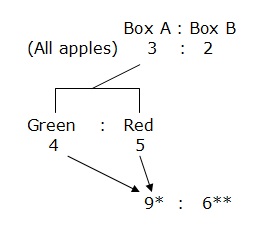
Red Swastika Sch 2011 PSLE Math Prelim Paper 2 Q8
The
ratio of the number of apples in Box A to the number of apples in Box B
is 3 : 2. All the apples in Box B are green. The ratio of the number of
green to the number of red apples in Box A is 4 : 5. There are 20 more
green apples in Box B than in Box A. How many red apples are there?
Solution
* 4 units of green apples + 5 units of red ---- 9 units in Box A
** 3 units in Box A (x 3) ---- 9 units, hence 2 units in Box B (x 3) will give 6 units.
Green Apples
Box B - Box A ----- 20
6 units - 4 units ----- 20
2 units ----- 20
1 unit ----- 20 divided by 2 = 10
Red Apples
5 units ----- 5 x 10 = 50
Answer: 50 red apples
Printer Friendly Version
Wednesday, May 16, 2012
Maths Q from a reader
A reader emailed me this question and I am too busy to solve it for him. Could readers please help him by posting the solution in the comments section. Thank you.
Mr Lim spent 885 on honey stars and pies. He spent 471 more on pies than on honey stars. The ratio of the number of packets of pies to the number of honey stars is 8:3. Each packet of pie is 0.45 more than honey stars. How many packets of honey stars did he buy?
Monday, February 27, 2012
Rosyth School 2011 CA1 Math Paper 2 Q17
Farmer Dan harvested some apples. He sold to Adam 3/4 of the apples and another 105 apples. He sold to Geraldine 3/4 of the remainder but took back 55 apples. Farmer Dan had 890 apples left.
a) How many apples did Geraldine have after returning 55 apples to Farmer Dan?
b) How many apples did Farmer Dan harvest?
Solution
1/4 of remaining ----- 890 – 55 = 835
3/4 of remaining ----- 3 x 835 = 2505
a) Geraldine ----- 2505 - 55 = 2450
b) 1 unit ----- 4/4 of remaining + 105
4/4 of remaining ----- 835 x 4 = 3340
1 unit ----- 3340 + 105 = 3445
(Total harvested) 4 units ----- 4 x 3445 = 13 780
Answer: a) 2450 apples b) 13 780 apples.
Monday, November 21, 2011
PSLE Results to be released on Thursday
PSLE results out Thursday
SINGAPORE: The results of the 2011 Primary School Leaving Examination (PSLE) will be released on Thursday.
The Ministry of Education (MOE) said pupils may obtain their result slips from their respective schools from 12noon.
Eligible pupils will also receive from their respective primary schools, their option forms to select secondary schools.
MOE said the results of Secondary 1 postings will be out on 21 December.
Nan Chiau High School, which has been designated a Special Assistance Plan school from January next year, will admit only Express course students offering Chinese or Higher Chinese as a Mother Tongue Language.
And two more schools - Victoria School and Cedar Girls - will take in their first batch of Secondary 1 students in the six-year integrated programme.
- CNA/ck
Tuesday, September 20, 2011
Catholic High School 2010 PSLE Math Prelim Paper 2 Q17
Daniel had 40% more stickers than Brandon. Daniel and Brandon each gave 20% of their stickers to Calvin. As a result, Calvin's stickers increased by 80%. If Daniel has 20 more stickers than Calvin in the end, how many stickers did Brandon have at first?
Solution
At first
Daniel ---- 100% + 40%
Brandon ---- 100%
Calvin ---- 1 unit
After Daniel and Brandon each gave 20% of their stickers to Calvin…
Daniel ---- 100% + 40% - (28%)*
Brandon ---- 100% - (20%)**
Calvin ---- 1 unit + (28% + 20% of Dan and Bran --> 80% of 1 unit)#
Hence Calvin --- 1 unit + (48% of Dan and Bran --> 80% of 1 unit)
* 20% of 140% = 28%
** 20% of 100% = 20%
# Cal received 28% + 20% = 48% of (Dan + Bran), which is equal to 80% of Cal's original amount of 1 unit.
80% of 1 unit ---- 48% of total of Dan and Bran
0.8 unit ---- 48%
1 unit ---- 48% divided by 0.8 = 60%
In the end Calvin
1 unit + (48% from Dan and Bran)
= 60% + 48%
= 108%
(Daniel) more than (Calvin) in the end
(140% - 28%)## - (108%)
= 112% - 108%
= 4%
## Danile had 140% at first but gave 28% to Calvin
Daniel had 20 more stickers than Calvin in the end
4% ---- 20
1% ---- 20 divided by 4 = 5
Brandon at first
100% ---- 100 x 5 = 500
Answer: 500 stickers
Printer Friendly Version
Wednesday, September 14, 2011
Catholic High School 2010 PSLE Math Prelim Paper 2 Q18
At a conference made up of speakers and participants, there were 20% more men than women. The ratio of male speakers to female speakers was 8:5. There was an equal number of male and female participants.
a) Find the ratio of male speakers to male participants at the conference.
b) Halfway, 40 male participants left the conference and another 60 female participants joined the conference. In the end, there were 3/4 as many male participants as female participants remaining behind. How many speakers were there at the conference?
Solution
Male ----- 120%
Female ----- 100%
Speakers
Male : Female
8 (parts) : 5 (parts)
Participants
Male : Female
1 (unit) : 1 (unit)
Men ----- 8 parts + 1 unit
Women ----- 5 parts + 1 unit
But since there are 20% more women than men,
Women ----- 5 parts x 120% + 1 unit x 120%
= 6 parts + 1.2 units
Men ----- Women
8 parts + 1 unit ----- 6 parts + 1.2 units
8 parts - 6 parts ----- 1.2 units - 1 unit
2 parts ----- 0.2 unit
1 part ----- 0.1 unit
10 parts ----- 1 unit
or
1 unit ----- 10 parts
(a)
Male Speakers ----- 8 parts
Male Participants ----- 1 unit or 10 parts
Male Speakers : Male Participants
8 : 10
4 : 5
Answer: 4 : 5
(b)
Speakers
Male : Female
8 (parts) : 5 (parts) -- (altogether 13 parts)
Participants
Male : Female
1 (unit) : 1 (unit)
10 (parts) : 10 (parts) -- (before)
- 40 : + 60 -- (40 males left; 60 females joined)
3 (units) : 4 (units) -- (3/4 as many male as females in the end)
(Male) 3 units ----- 10 parts - 40
(Female) 4 units ----- 10 parts + 60
(Female) - (Male)
4 units - 3 units ----- 10 parts + 60 - 10 parts - (-40)
1 unit ----- 60 + 40
1 unit ----- 100
(Male after)
3 units ---- 3 x 100 = 300
(Male before)
10 parts ---- 300 + 40 (need to add the 40 who left)
10 parts ----- 340
1 part ---- 34
All speakers
13 parts ---- 13 x 34 = 442
Answer: 442 speakers
Printer Friendly Version
Wednesday, September 07, 2011
Hokkien Huay Kuan Combined Primary 2010 PSLE Math Prelim Paper 2 Q18
The figure below shows 2 completely-filled tanks being emptied of the water from 2 different taps.
The taps at Tank A and Tank B were turned on at 7 am and 8.30 am respectively, until both tanks were completely empty. At 11 am, the water level in both the tanks was the same. At 12.30 pm, Tank B was completely empty and Tank A was only completely empty at 1 pm. If the rate of the flow of water from each tap was constant throughout, what was the height of Tank A?
Solution
** At 11 am, water level in both Tanks were the same.
Note that 3/8 of B's height is the same as 2/6 or 1/3 of A's height.
(3/8) of B ----- (2/6) or (1/3) of A
(1/8) of B ----- (1/3) of A divided 3 = (1/9) of A
(8/8) of B (B's height) ----- 8 x (1/9) = (8/9) of A
* Remaining (1/9) of A ----- 5 cm
(This is the difference in height between Tank A and B)
(9/9) of A (A's height) ----- 9 x 5cm = 45 cm
Answer: 45 cm
Printer Friendly Version
Hokkien Huay Kuan Combined Primary 2010 PSLE Math Prelim Paper 2 Q17
The average length of 6 ropes was 80 cm. The average length of 4 ropes of the ropes A, B, C and D was 15 cm more than the average length of the remaining 2 ropes E and F.
a) Find the average length of ropes E and F. Give your answer in metres.
b) If Rope E had been 18 cm shorter and Rope F had been 12 cm longer, they would have been of the same length. Find the actual length of Rope E.
Solution
Total of 6 ropes ----- 6 x 80cm = 480 cm
Average of A, B, C, D (4 ropes) is more than Average of E and F (2 ropes) by 15 cm.
This means each of the 4 ropes (A, B, C, D) has an average length that is 15 cm longer than the average of E and F.
Therefore, total length of A, B, C, D is longer than total length of E and F by
----- 4 x 15cm = 60 cm
a)
3 units ----- 480cm - 60cm = 420 cm
1 unit (E + F) ----- 420cm divided by 3 = 140 cm
Average ----- 140cm divided by 2 = 70 cm or 0.7 m
Answer: 0.7 m
b)
2 parts ----- 140 - 12 - 28 = 110
1 part ----- 110 divided by 2 = 55
E ----- 55 + 12 + 18 = 85
Answer: 85 cm
Printer Friendly Version
Subscribe to:
Posts (Atom)

